
ImageGPT Image 2
Character Consistency Reference Chart
A technical prompt for creating a visual reference board to lock character identity across multiple angles, expressions, and details.
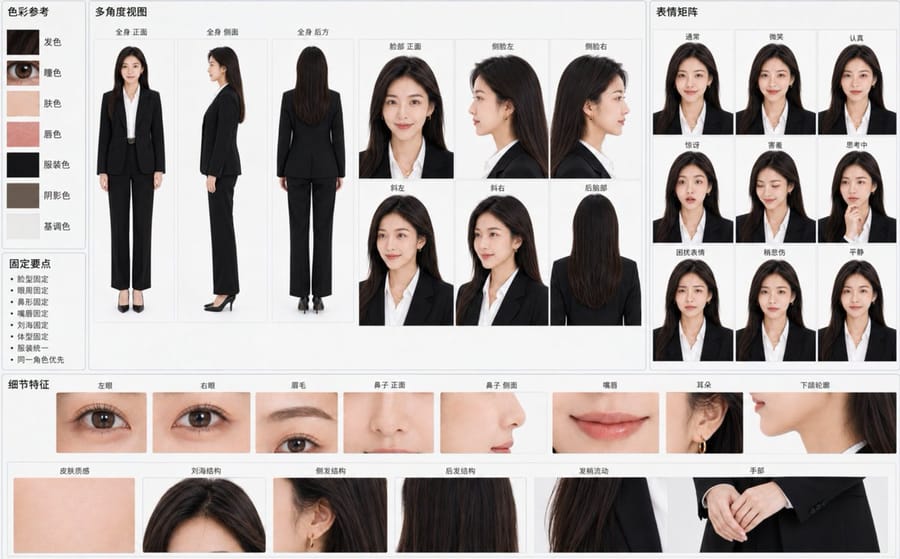
Créer un "{argument name="chart title" default="Tableau de Référence de Cohérence d'Identité de Personnage"}" basé sur l'image originale du personnage jointe, {argument name="ratio" default="16:10"} horizontal, {argument name="background color" default="fond gris clair-blanc"}, mise en page de tableau de données visuelles professionnelle. L'objectif principal est de rendre tous les panneaux clairement reconnaissables comme étant exactement le même personnage d'un coup d'œil, plutôt que plusieurs individus similaires.

Traitez l'identité du personnage dans l'image de référence comme une contrainte rigide et immuable. Verrouillez strictement :

- Ratio largeur/hauteur du visage, pommettes, joues, mâchoire et menton
- Contours des yeux, distance entre les yeux, structure des paupières et tempérament du regard
- Arc des sourcils, épaisseur, couleur et distance sourcil-œil
- Pont du nez, pointe, narines et forme de profil du nez
- Épaisseur des lèvres supérieures/inferieures, sommet des lèvres, coins et couleur naturelle des lèvres
- Teint de la peau, pores, rougeurs et texture naturelle de la peau
- Ligne des cheveux, raie, frange, cheveux latéraux, longueur des cheveux arrière et flux des mèches de cheveux
- Impression d'âge, cadre squelettique, largeur des épaules, longueur des membres et type de corps général
- Vêtements originaux, style artistique original, texture légère et atmosphère générale

Utilisez de grands panneaux au centre pour afficher :

- Corps entier de face
- Corps entier de côté
- Corps entier de dos
- Visage de face
- Profil gauche
- Profil droit
- Trois-quarts gauche
- Trois-quarts droit
- Arrière de la tête

Maintenez une structure crânienne parfaitement cohérente, la position relative des traits du visage, le volume des cheveux et les proportions du corps pour chaque angle. Le profil doit continuer avec précision la structure du pont du nez, des lèvres, du menton et du front depuis l'avant ; générer des profils de style de personnage différents est interdit.

Configurez une petite matrice d'expressions sur la droite :

- Normal
- Sourire
- Sérieux
- Surpris
- Timide
- Pensif
- Troublé
- Légèrement triste
- Calme

Maintenez les mêmes pupilles, taille de base des yeux, forme du nez, forme des lèvres et forme du visage. Les sourires doivent être naturels et contenus, sans changer l'âge ou le tempérament du personnage.

Configurez des ancres d'identité fines en bas :

- Œil gauche / Œil droit / Sourcils
- Nez (de face/de côté) / Lèvres / Oreilles
- Contour de la mâchoire / Texture de la peau
- Frange / cheveux latéraux / structure des cheveux arrière / flux des extrémités des cheveux
- Mains

Ajoutez 5 à 7 échantillons de couleur précis sur la gauche : cheveux, yeux, peau, lèvres, vêtements, ombre et couleur de ton. Ajoutez des "Points de Fixation" minimalistes : forme du visage fixée, zone des yeux fixée, forme du nez fixée, lèvres fixées, frange fixée, type de corps fixé, vêtements unifiés, priorité au même personnage.

Fond propre, éclairage uniforme doux, pas d'éclairage cinématographique, forte profondeur de champ ou éléments décoratifs. Les personnages réalistes conservent des pores naturels, des cheveux fins et de légères variations de teint ; les personnages non réalistes maintiennent strictement les lignes, blocs de couleur, ombres et matériaux de l'image originale sans conversion de style non autorisée.

Tous les labels utilisent un chinois simplifié clair, taille de police modérée, sans chevauchement de caractères. Si l'espace est insuffisant, priorisez les ancres d'identité et les angles principaux, réduisez les panneaux en double et ne forcez pas une mise en page complète en réduisant le texte ou en sacrifiant la cohérence du personnage.Comment utiliser ce prompt
- 1Copiez le prompt tel quel, puis collez-le dans votre modèle préféré ou votre projet Ideart.
- 2Remplacez les détails de produit, sujet, audience et style par votre propre contexte.
- 3Générez d’abord un résultat de base, puis remixez la direction la plus forte en campagne, série d’images ou concept vidéo.
Créer à partir de ce prompt
Transformez un prompt image en projet créatif terminé.
Enregistrez le prompt, ajoutez des images de référence ou des notes, et laissez Ideart façonner la prochaine étape de production dans le même fil créatif.